
Anyone who has lived in Murfreesboro through a storm season knows the routine. The wind picks up, the rain comes sideways, and somewhere across Rutherford County a tree limb finds a power line. Middle Tennessee Electric, which serves Murfreesboro and most of the surrounding county, usually has crews out quickly, but “quickly” can still mean several hours without power, and occasionally it means a day or more. That has more homeowners asking the same question: should we get a generator, or would a battery backup system make more sense? The honest answer is that it depends on your home, your budget, and what you actually need to keep running. Here is how the two options compare.
Why Murfreesboro Homes Lose Power in the First Place
Most Rutherford County outages stem from fairly ordinary causes: a storm-damaged line, a tree limb across a distribution line, an ice-loaded branch during a winter event, or, occasionally, a problem upstream at a TVA substation feeding the area. In 2021, for example, damage to a single TVA transmission structure left more than 10,000 Murfreesboro-area accounts without power for several hours. It is not the multi-week recovery you would see after a Gulf Coast hurricane, but it is still presents challenges when it occurs. A few hours without power is an inconvenience. A day or two, especially in August heat or a January cold snap, is when a backup power plan starts to matter.
Portable Generators: The Starting Point
A portable generator is the option most homeowners already know. You can buy one for roughly $500 to $2,500 depending on wattage, and it will typically run a refrigerator, a sump pump, some lights, and maybe a window AC unit if you are careful about the total load.
The catch is that a portable generator is only as useful as the way it is connected. Plugging appliances directly into it with heavy-duty extension cords works in a pinch, but powering your home’s actual circuits from a portable generator requires a manual transfer switch, which generally adds $400 to $1,300 in installation costs. Trying to “backfeed” your panel through a dryer outlet instead is a serious hazard. It can send power back onto lines that utility crews are treating as de-energized, and it is a well-documented risk that every line crew is trained to watch for. If a portable generator is your plan, the transfer switch is not optional, and it belongs in the hands of a licensed electrician.
Two more portable-generator safety points that get overlooked every storm season: never run one in a garage, basement, crawlspace, or anywhere near an open window, because carbon monoxide from the exhaust is odorless and can build up fast. And store your fuel safely, since gasoline goes stale in a matter of months and a generator that will not start on the night you need it is just a heavy box.
Whole-Home Standby Generators: Set It and Forget It
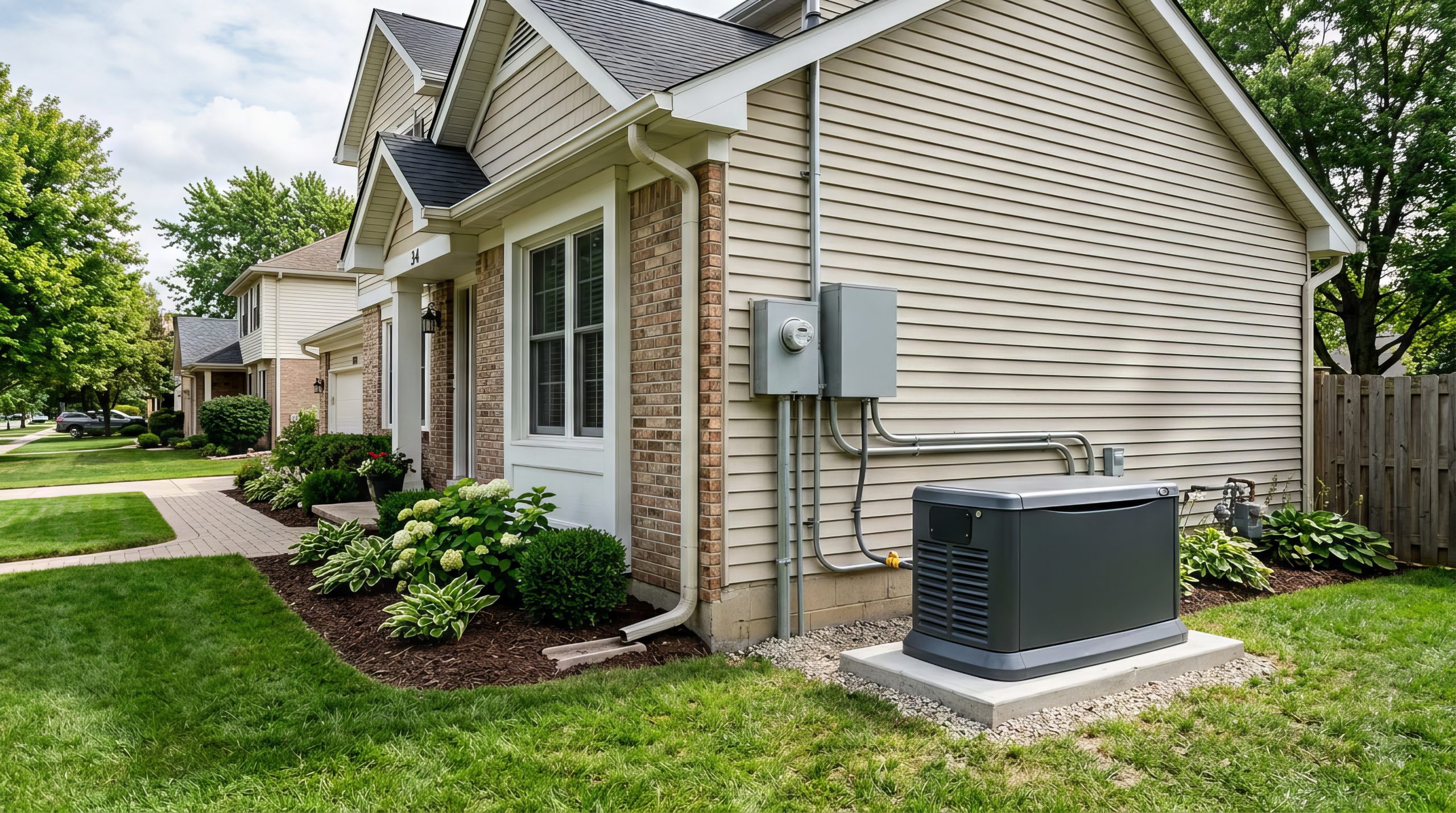
A standby generator sits outside on a pad, wired permanently into your electrical system, and starts on its own within seconds of an outage. No cords, no manual startup, no trip outside in the rain at 2 a.m. These units typically run on natural gas or propane and are sized in kilowatts, commonly 8kW to 24kW for a residential install, depending on square footage and whether you want whole-home coverage or just the essential circuits like the fridge, furnace, well pump, and a few lights and outlets.
Fully installed, including the unit, automatic transfer switch, pad, fuel line connection, permit, and inspection, most homeowners nationally land somewhere between $7,000 and $20,000, with properly sized whole-home systems most often falling in the $10,000 to $15,000 range. Systems covering only essential circuits generally come in lower. Your actual number depends heavily on site conditions, so treat these as planning ranges rather than a quote.
Two practical notes for Murfreesboro specifically. First, natural gas here is provided by Atmos Energy, but not every home has a gas line at the meter. If yours does not, you are looking at a propane tank, which adds cost and means your runtime is limited by tank capacity rather than being effectively continuous. Second, a standby generator is permitted electrical work, and gas connections carry their own requirements, so this gets inspected. That protects you at resale and keeps the manufacturer’s warranty intact.
One thing generator salespeople sometimes skip: standby units need routine maintenance. They run a weekly or biweekly self-test cycle, and they need periodic oil changes, filter changes, and battery replacement, much like a small engine in anything else. Budget for annual service.
Battery Backup Systems: The Quiet Alternative
A home battery system, such as a Tesla Powerwall or a comparable unit from Enphase, FranklinWH, or others, stores electricity and switches over automatically and almost instantly when the grid drops. A single unit typically holds 10 to 15 kWh, which covers essential circuits for roughly 8 to 24 hours depending on what you are running. Homeowners with solar can recharge the battery during daylight hours in the middle of an outage, which turns a short-term bridge into something much closer to indefinite power. Without solar, the battery only holds whatever charge it had when the grid went down.
Installed cost for a single unit generally runs $8,000 to $16,000 or more depending on brand, whether your panel needs an upgrade, and site conditions. Multiple units can be paired for whole-home coverage, which raises the cost accordingly.
An important budgeting note for 2026: the 30% federal Residential Clean Energy Credit (Section 25D) that used to apply to home battery storage was terminated by the One Big Beautiful Bill Act and does not apply to systems installed after December 31, 2025. If you buy a battery outright this year, do not plan on that credit. Some state, local, and utility programs may still offer incentives, and systems obtained through a lease or power purchase agreement may qualify under a different section of the tax code, so it is worth asking your installer and confirming with a tax professional.
Generator vs. Battery Backup: Quick Comparison
| Portable Generator | Standby Generator | Battery Backup | |
| Startup | Manual | Automatic, within seconds | Automatic, nearly instant |
| Fuel or power source | Gasoline | Natural gas (continuous) or propane (limited by tank) | Stored charge, recharged by grid or solar |
| Runtime | Limited by fuel on hand | Days or longer on natural gas | 8 to 24 hrs per unit, longer with solar |
| Noise | Loud | Moderate | Silent |
| Maintenance | Fuel management, seasonal service | Annual service, self-test cycles | Minimal |
| Typical installed cost | $900 to $3,800 with transfer switch | $7,000 to $20,000 | $8,000 to $16,000+ |
| Best for | Occasional short outages on a budget | Frequent or extended outages, whole-home needs | Short outages, solar homes, noise-sensitive setups |
Which One Makes Sense for Your Rutherford County Home?
A few honest questions usually settle it:
- How often and how long do your outages actually run? If it is a couple of hours a few times a year, a properly installed portable setup may be plenty. If you have lost power for a full day more than once, a standby generator starts earning its cost in peace of mind alone.
- Is there something in your home that truly cannot lose power? Medical equipment, a well pump, a sump pump, or a home office you cannot afford to go dark all push toward whole-home coverage rather than a partial setup.
- Do you have solar, or plan to add it? A battery pairs naturally with solar and becomes considerably more valuable as a result. Without solar, it is a shorter-term bridge than a generator.
- Do you have natural gas at the house? If yes, a standby generator gets simpler and its runtime gets much better. If no, factor in a propane tank.
- Does noise or fuel storage matter to you? Some neighborhoods and HOAs have restrictions on visible tanks or equipment noise. A battery sidesteps both.
- Could you use both? Some homeowners pair a smaller battery for instant, silent switchover with a standby generator for extended outages. It is not overkill if your household genuinely depends on staying powered.
Common Questions About Generators and Battery Backup
How much does a whole-home generator cost? Most fully installed standby systems run $7,000 to $20,000, with a typical properly sized system landing between $10,000 and $15,000. Size, fuel type, distance from the panel, and site conditions drive the difference, so get a written scope before comparing bids.
Can I install a generator transfer switch myself? No. Connecting a generator to your home’s wiring without a licensed, code-compliant transfer switch can push power back onto lines that utility crews are treating as de-energized. It is a genuine safety hazard and a job for a licensed electrician.
How long can a battery backup power my home? A single battery typically covers essential circuits for 8 to 24 hours. Paired with solar, it can recharge during the day and extend well beyond that.
Do I need a permit for a home generator or battery in Rutherford County? In nearly all cases, yes. Standby generators involve permitted electrical work plus a gas connection, and battery systems typically require an electrical permit as well. A licensed installer should pull the permit and schedule the inspection as part of the job. Confirm requirements with your local codes department, since they differ inside and outside Murfreesboro city limits.
Is a generator or battery backup the better investment? Neither is universally better. A generator handles longer outages and does not depend on stored charge, while a battery is silent, needs no fuel, and pairs well with solar. Most homeowners decide based on how long their typical outages last and whether solar is part of the plan.
Is there still a federal tax credit for home battery storage? Not for systems purchased outright and installed in 2026. The 30% Residential Clean Energy Credit ended for expenditures made after December 31, 2025. State, local, or utility incentives may still apply, and lease or PPA arrangements may qualify differently, so check with a tax professional.
Ready to Stop Guessing About Backup Power?
Every home is a little different, and the right answer usually comes down to a real look at your panel, your typical outages, and what you actually need to keep running. Dutton Electric can walk your property, talk through the options honestly, and size a system that fits your home rather than a one-size-fits-all package. Give us a call at 615-416-5954 to schedule an assessment before the next storm rolls through Rutherford County.