
Every room in your home has its own electrical needs, and its own set of code requirements built around how that room is actually used. A kitchen has very different demands than a bedroom. A bathroom has stricter safety rules than a living room. A garage has requirements that surprise most homeowners. Understanding what each room should have helps you spot problems, plan upgrades, and know when something is not right.
This walkthrough takes you through the home room by room, covering what the electrical should look like in each space, what is commonly wrong, and what modern code expects. It is written for homeowners in Murfreesboro and Rutherford County who want to understand their own homes better, whether you are planning a remodel, buying a house, or just curious about what is behind your walls.
One note before we start. Code requirements have grown stricter over the years, and older homes are often grandfathered in, meaning they were legal when built and do not automatically have to be updated. But when you remodel a room or update its wiring, the new work generally has to meet current code. Knowing the current standard helps you understand where your home stands.
The Kitchen
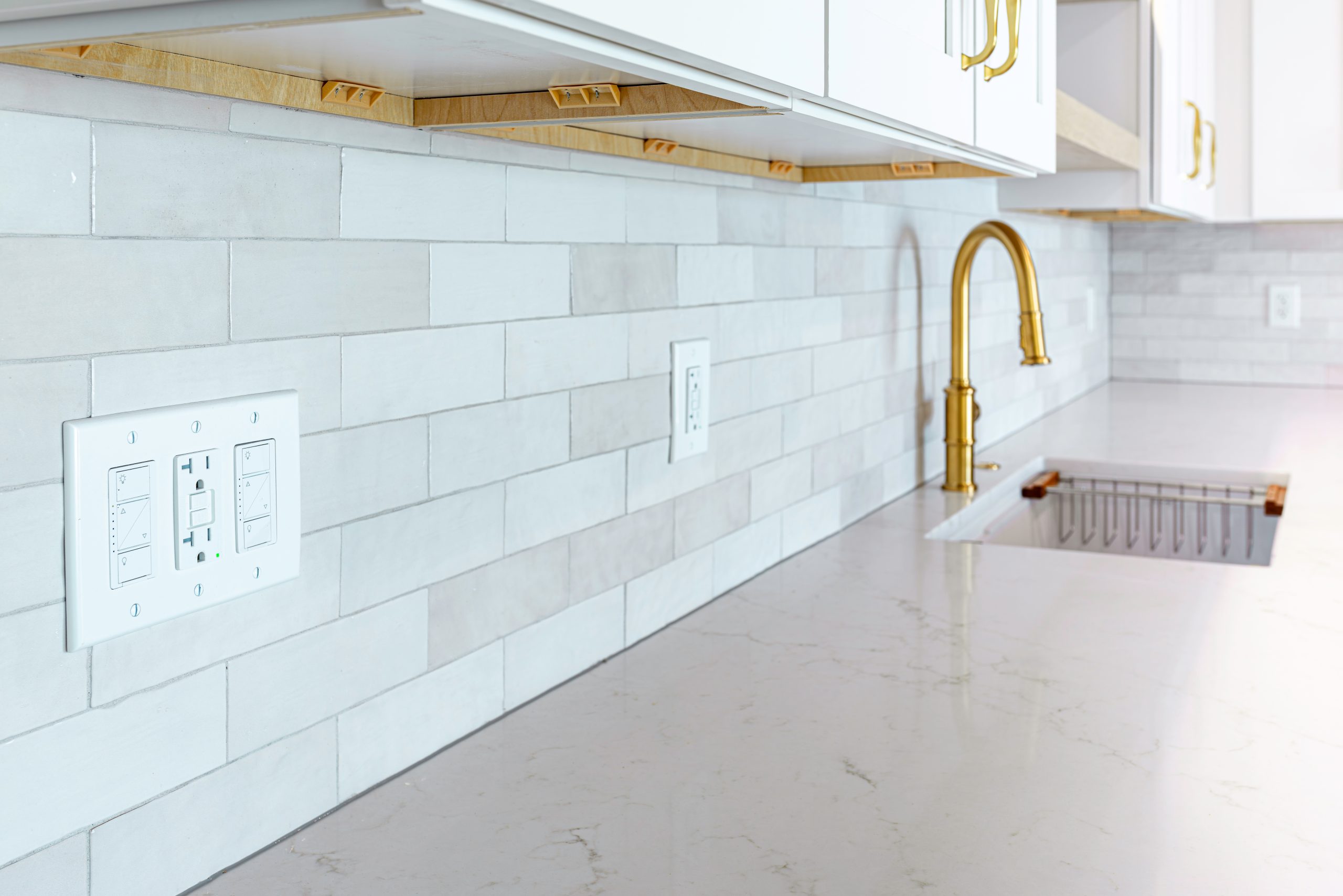
The kitchen is the most electrically demanding room in the house, and it has the strictest outlet requirements of any living space. Modern kitchens run refrigerators, microwaves, dishwashers, and a rotating cast of countertop appliances, and the code reflects that.
Countertop outlets follow a much tighter spacing rule than the rest of the house. Along a kitchen counter, no point can be more than 24 inches from an outlet, which works out to a maximum of 4 feet between receptacles. Any section of countertop 12 inches or wider needs its own outlet. This tight spacing exists because kitchen appliances come with short cords, by design, so they do not dangle over counter edges or near the stovetop.
Kitchens also require at least two dedicated 20-amp small appliance circuits to serve the countertop and eating areas. These are separate from the circuits running your lights, and they exist so that running the toaster and the microwave at the same time does not trip a breaker. Countertop outlets within reach of the sink require GFCI protection, and current code calls for GFCI protection on essentially all kitchen receptacles.
Major kitchen appliances typically get their own dedicated circuits. The refrigerator, dishwasher, garbage disposal, microwave, and electric range each draw enough power that sharing a circuit would cause problems. If your kitchen frequently trips a breaker when a few appliances run at once, it is a sign the circuits are undersized or overloaded for how you use the space.
The Bathroom
Bathrooms combine water and electricity in a small space, so the safety requirements are strict. The single most important one is GFCI protection. Every bathroom receptacle must be GFCI-protected, without exception. If your bathroom outlets do not have the test and reset buttons, or are not protected by a GFCI elsewhere on the circuit, that is a safety gap worth closing.
Bathrooms also require at least one dedicated 20-amp circuit to serve the receptacles. Hair dryers, curling irons, and space heaters draw significant power, and the dedicated circuit keeps them from overwhelming a shared line. There is a code nuance here: that 20-amp circuit can serve the receptacles in multiple bathrooms, or it can serve everything in a single bathroom including the lighting and fan, but not both arrangements at once. In practice, a licensed electrician sorts out the right configuration for your home.
One thing bathrooms do not require is AFCI protection, because the damp environment can cause arc-fault breakers to trip unnecessarily. Bathrooms are GFCI territory, not AFCI territory. This is a common point of confusion.
Bedrooms
Bedrooms follow the general room spacing rule that applies to most living spaces: no point along a wall can be more than 6 feet from an outlet, which means receptacles spaced no more than 12 feet apart. The logic is that a standard lamp or appliance cord is about 6 feet long, so you should always be able to reach an outlet without an extension cord. Any wall section 2 feet or wider needs its own outlet, which means even a short wall between two doorways requires a receptacle.
The defining electrical requirement for bedrooms today is AFCI protection. Arc Fault Circuit Interrupters detect the dangerous arcing that happens when wiring is damaged or connections loosen, the kind of fault that a regular breaker will not catch and that can start a fire inside a wall. Bedrooms were the first rooms where AFCI protection became required, and if your home was built before 2002, your bedrooms likely have no AFCI protection at all. Adding it is a worthwhile safety upgrade, especially in older homes.
If you find yourself running extension cords and power strips throughout a bedroom, that is usually a sign the room does not have enough outlets for modern needs. Bedrooms have become home offices, entertainment spaces, and charging stations, and older homes often were not wired with that in mind.
Living Rooms and Family Rooms
Living rooms, family rooms, dens, and similar spaces follow the same 6-foot and 12-foot spacing rule as bedrooms, and like bedrooms, they now require AFCI protection under current code. The 2008 code expanded AFCI requirements well beyond bedrooms to cover most living areas of the home, so a newer home should have broad AFCI coverage while an older one may have little or none.
The most common electrical issue in living areas is simply not enough capacity for modern life. Entertainment centers, gaming systems, multiple TVs, sound equipment, and a growing number of charging devices all draw power, and a room wired decades ago for a lamp and a television can end up with a tangle of power strips. If your living room relies on daisy-chained power strips and extension cords, it is worth having additional dedicated outlets installed rather than continuing to overload what is there.
The Garage
The garage is where homeowners are most often surprised by what code requires, because garage requirements have expanded significantly in recent years.
All garage receptacles require GFCI protection. Garages are treated as areas where moisture and outdoor conditions are a factor, so the same protection required outdoors applies here. Current code also requires at least one dedicated 20-amp circuit to serve receptacles in each vehicle bay of the garage, which reflects how garages have become workshops, charging areas, and appliance spaces rather than just parking spots.
The garage is also where EV charging usually lives. A Level 2 EV charger needs a dedicated 240-volt circuit, and whether your panel can support one depends on its capacity and current load. If you drive an electric vehicle or plan to, the garage electrical is worth evaluating before you buy a charger. Freezers and refrigerators in the garage also benefit from proper dedicated circuits, since a nuisance GFCI trip on a shared circuit can quietly ruin a freezer full of food.
The Laundry Room
Laundry rooms have specific requirements built around the appliances they serve. Code requires at least one dedicated 20-amp circuit for the laundry receptacles, and this circuit is for laundry equipment only. It cannot be shared with lighting or outlets in other rooms.
An electric dryer is a different matter entirely. It requires its own dedicated 30-amp, 240-volt circuit with the appropriate four-conductor cable and outlet. This is a much larger circuit than the standard laundry receptacle circuit, and it is not something to improvise. A gas dryer, by contrast, only needs a standard 120-volt outlet for its controls and can share the 20-amp laundry circuit.
Current code also requires GFCI protection for laundry area receptacles. If your laundry room is older and the outlets are not GFCI-protected, that is a gap worth addressing, particularly given the water present in the room.
Outdoor Areas
Outdoor electrical has its own rules, driven by exposure to weather and the presence of water. Every outdoor receptacle must be GFCI-protected, and outdoor outlets must be in weatherproof enclosures with in-use covers, meaning the cover seals around a plug while it is being used, not just when the outlet is empty.
Code generally requires at least one accessible outdoor receptacle at the front and back of the home. Beyond that, most homeowners want more, for holiday lighting, landscape lighting, outdoor entertaining, and equipment. Any outlet within 20 feet of a pool or hot tub has additional requirements, and receptacles must be kept a safe distance from the water. Outdoor lighting, whether low-voltage landscape lighting or line-voltage fixtures, uses methods and materials rated for wet locations.
Frequently Asked Questions
How many outlets should a room have?
For most living spaces, code requires outlets spaced so that no point along a wall is more than 6 feet from a receptacle, which means one roughly every 12 feet, plus one for any wall section 2 feet or wider. Kitchens require much tighter spacing along countertops, with no point more than 24 inches from an outlet. These are minimums, and many homeowners choose to add more outlets for convenience, especially in rooms full of electronics.
Which rooms require GFCI protection?
Under current code, GFCI protection is required in kitchens, bathrooms, garages, laundry areas, unfinished basements, crawl spaces, and outdoors, along with any receptacle near a sink or water source. Essentially, anywhere moisture is a factor. Bathrooms and outdoor areas require it without exception.
Which rooms require AFCI protection?
AFCI protection is required in most living areas, including bedrooms, living rooms, family rooms, dining rooms, hallways, and similar habitable spaces, as well as kitchens and laundry areas under current code. Bathrooms, garages, and outdoor areas are generally not AFCI areas because the environment can cause nuisance tripping. Those are GFCI zones instead.
Why does my kitchen keep tripping the breaker?
The most common cause is running too many appliances on the same circuit. Kitchens are supposed to have at least two dedicated 20-amp small appliance circuits, plus dedicated circuits for major appliances. If your kitchen was wired years ago or has been modified, it may not have enough circuits for how you use it. A licensed electrician can evaluate the circuit layout and add capacity where needed.
Do older homes have to be brought up to current code?
Not automatically. Electrical work that was legal when it was installed is generally grandfathered in, so an older home does not have to be rewired just because the code has changed. However, when you remodel a room or update its wiring, the new work typically has to meet current code. And some older configurations, while grandfathered, are worth updating for safety regardless of whether they are technically required.
How do I know if my home’s wiring is safe?
The clearest way is to have a licensed electrician perform a home electrical evaluation. Many issues are not visible without checking the panel, testing outlets, and inspecting connections. Warning signs you can notice yourself include frequent breaker trips, warm outlets or switch plates, flickering lights, a burning smell, and a heavy reliance on extension cords and power strips. Any of these is a reason to have the system looked at.
Understanding Your Home, Room by Room
Knowing what the electrical should look like in each room of your home puts you in a better position to spot problems, plan improvements, and make smart decisions when you remodel or buy. Every room is wired around how it is used, and the requirements exist to keep your home safe and capable.
Dutton Electric serves homeowners across Murfreesboro, Smyrna, La Vergne, Rockvale, Walterhill, and Rutherford County for electrical evaluations, outlet and circuit additions, GFCI and AFCI upgrades, panel work, and whole-home electrical improvements. Drew brings 23 plus years of experience and is fully licensed and insured. Whether you are planning a project or just want a clear picture of your home, call (615) 416-5954 or visit duttonelectrictn.com.
Tennessee Licensed Electrician #82842 | Murfreesboro License #1576